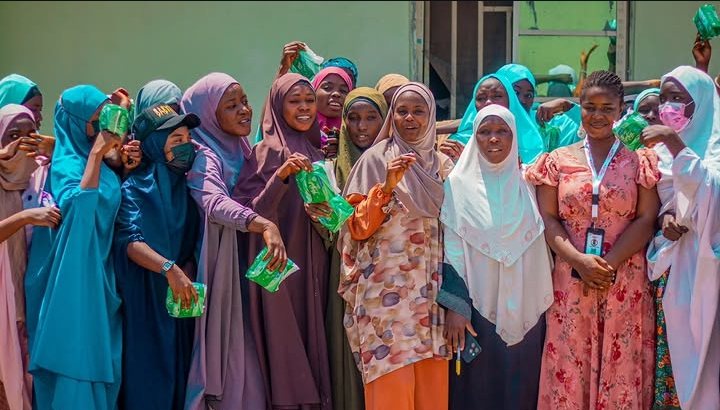
It is no news that early girl child marriage is still practiced in parts of Nigeria, but what happens when a girl who has barely had the opportunity to receive an education, understand her emotions or learn about her own body is pushed into marriage? What happens when she is expected to assume the responsibilities of adulthood before she has had the opportunity to experience childhood fully?
As the world marks the girl child international day on 11 October with the theme "End child marriage and invest in her rights" it doesn't just mean celebrating a girls potential; it also means creating systems that allows every girl realize it and one important way to doing that is educating a girl child on her menstrual health.
Menstruation is a natural biological process yet the experience of menstruating remains unnecessarily difficult for many girls. A lack of affordable menstrual products, inadequate sanitation facilities, limited access to accurate information and the stigma created surrounding periods can make an ordinary biological experience a source of fear and embarrassment.
For a girl who cannot afford sanitary pads, managing her period may mean staying home from school, for another it could be the absence of clean water and private toilets may make attending school during menstruation uncomfortable or difficult. Some girls experience teasing and discrimination simply because their bodies are developing as they should.
These challenges may appear small to those who have never experienced them, but their consequences can be significant. When girls cannot manage their menstruation safely and confidently, their education, participation and well being may suffer entirely. Investing in girls' rights must therefore include ensuring that every girl has access to menstrual health education, affordable products, adequate sanitation and appropriate healthcare.
A girl's period should never become a barrier to her education, dignity or opportunities.
When Puberty is Mistaken for Readiness for Marriage
It may seem as though menstrual health and child marriage are not connected because one concerns a biological process, while the other involves social practices, harmful power dynamics and violations of children's rights.
However, I believe the relationship between them deserves careful attention; menstruation is often one of the visible signs of puberty. In some communities, menstruation is wrongly interpreted as evidence that a girl is ready for marriage or motherhood. Yet, the beginning of menstruation does not mean that a girl is physically, emotionally or developmentally ready for marriage, pregnancy or the responsibilities of adulthood.
Puberty marks a stage of biological development; it does not necessarily mean adulthood.
The consequences of child marriage remain significant. According to UNICEF, approximately 650 million women and girls alive today were married before their 18th birthday. The organisation also reports that around 12 million girls are married during childhood each year.
These numbers represent more than statistics. They represent girls whose education, personal development and opportunities may be interrupted by responsibilities they were not yet prepared to assume.
When communities confuse physical maturity with readiness for marriage, girls may face pressure to enter unions before they are prepared to make such life changing decisions. Menstrual health education can help challenge these misconceptions by explaining puberty, reproductive development and the importance of protecting children's rights.
It is true that education is important but education alone cannot end child marriage. Poverty, gender inequality, insecurity, harmful social norms and limited educational opportunities also contribute to the practice. Addressing child marriage therefore requires coordinated efforts involving families, communities, schools, healthcare providers and governments.
Menstrual health education is one part of this wider response. It helps ensure that girls understand their bodies and that the adults around them recognise puberty as a stage requiring care, guidance and protection not a signal that a child should be married.
Menstrual Health Is an Education Issue
Education gives girls knowledge, expands their choices and helps them participate more fully in decisions affecting their lives. Yet, when menstruation is surrounded by shame or becomes difficult to manage, girls may encounter additional obstacles to learning.
For instance a school girl who has no access to menstrual products and fears staining her uniform or another who experiences severe menstrual pain but has nowhere to seek assistance or a girl who has never been taught what menstruation is and is frightened when she experiences her first period.
These are not merely individual inconveniences they point to gaps in the systems responsible for supporting girls.
Schools must be places where girls can learn about their bodies without embarrassment and manage menstruation without fear. This requires accurate, age appropriate menstrual health education, clean and private toilets, access to water, appropriate disposal facilities and affordable menstrual products.
It also requires including boys in menstrual health education. Menstruation should not be treated as a source of ridicule or as a subject that boys must never understand. When boys are taught to approach menstruation with respect, schools can become more supportive environments for everyone.
What Investing in Girls Means
Investing in girls means removing preventable barriers to their participation, rather than expecting them to overcome those barriers alone.
Providing sanitary pads is important, but menstrual health extends beyond the distribution of products.
Girls need the freedom to ask questions about their bodies, access reliable health information and seek medical care when and where necessary. They need adults who will listen without shaming them and communities that recognize their right to safety and dignity.
They also need to understand that their bodies belong to them and that they deserve protection from coercion, abuse and harmful practices.
A girl who understands her body is better equipped to recognize when something is wrong, ask for help and participate in informed decisions about her health.
If we are serious about ending child marriage and investing in girls' rights, menstrual health must be part of the conversation.
Governments should strengthen policies and programmes that improve access to affordable menstrual products. Schools should provide accurate information about menstruation. Parents and community leaders should challenge misconceptions that associate menstruation with readiness for marriage.
Menstrual health organisations should continue raising awareness, addressing stigma, supporting underserved communities and advocating for policies that recognize menstrual health as an essential component of girls' well being.
And girls themselves must be heard. Their experiences, concerns and proposed solutions should inform the programmes designed to serve them.
I see the International Day of the Girl Child as an opportunity to reflect on the kind of future we are creating for girls.
A future where a girl understands her body without shame, where she can attend school during her period without fear or embarrassment, where puberty is met with guidance and protection rather than pressure to marry, where her dreams are not limited by poverty, discrimination or the circumstances into which she was born.
Ending child marriage means protecting girls from being pushed prematurely into adulthood. Investing in menstrual health means ensuring they have the knowledge, resources and support to navigate their development safely and confidently.
Both efforts recognize the same fundamental truth: girls are children with rights, not adults simply because their bodies are changing.
Let us invest not only in the futures we imagine for girls but also in the health, dignity, education and freedom they deserve today.
Because when we protect a girl's right to understand and care for her body, we affirm her right to learn, to choose, to grow and to become.
And when we invest in those rights, we invest in a future where every girl has the opportunity to reach her full potential.