THE GIRL WHO WROTE A LETTER TO HER WOMB
An original story about menstrual health, silence, shame, and the courage to understand one’s body.
“Dear Womb, if you could speak, would you tell me why you make me suffer for something I never asked for?”
That was the first sentence eighteen-year-old Zara wrote in her diary on a rainy Thursday evening.
She stared at the words for a long time before closing the book.
It was a strange letter to write, especially to an organ she had never seen. But Zara had spent six years being angry at a part of herself she barely understood.
Every month, her body reminded her that she was a woman, and every month, she wished she could escape that reminder.
Not because she hated being female.
But because nobody had taught her how to love a body that sometimes hurt her.
Chapter One: The Day Her Skirt Told a Story
Zara was twelve when she first learned that blood could make a person feel ashamed without being injured.
It happened on a Tuesday afternoon.
The classroom was unusually noisy, and the mathematics teacher had just announced a surprise test. Zara was reaching for her pen when she felt something warm beneath her.
At first, she ignored it.
Then came the discomfort.
She shifted in her seat, hoping it would disappear.
It didn’t.
When the bell rang, she stood up, and a boy sitting behind her shouted,
“Zara! What happened to your skirt?”
The classroom went silent for a second.
Then came the laughter.
She turned around and saw a reddish stain spreading across the back of her cream-coloured uniform.
Her heart began to race.
She had heard older girls whisper about menstruation, but nobody had explained what it would feel like when it finally happened to her.
She didn’t know whether to cry, run, or disappear.
A girl named Esther quietly removed her sweater and tied it around Zara’s waist.
“Come,” she whispered. “I’ll take you to the toilet.”
Inside the toilet, Zara cried as though something terrible had happened.
“Am I sick?” she asked.
Esther shook her head.
“No. I think you’ve started your period.”
“Then why were they laughing?”
Esther had no answer.
And that silence became Zara’s first lesson about menstruation.
Not that it was natural.
Not that it was part of growing up.
But that it was something to hide.
Chapter Two: The Rules Nobody Questioned
By fourteen, Zara had learned the unofficial rules of menstruation.
Never let a boy see your sanitary pad.
Never mention your period loudly.
Never allow anyone to know when you are menstruating.
If you stain your clothes, pretend nothing happened.
If the pain becomes unbearable, endure it quietly.
Her mother wasn’t cruel. She simply passed down the lessons she had received.
“Be careful with these things,” she would say while wrapping sanitary pads in old newspapers. “You’re a young lady now.”
Zara always wondered what being a young lady had to do with hiding a perfectly normal bodily function.
But she never asked.
Questions about menstruation seemed to make adults uncomfortable.
So she learned to be uncomfortable too.
She became an expert at concealing pads inside textbooks, checking chairs before standing, and calculating how quickly she could get to the toilet without attracting attention.
Yet she knew almost nothing about her menstrual health.
She didn’t know that menstrual cycles could vary in length.
She didn’t know that tracking her period could help her recognise changes.
She didn’t know that severe pain interfering with everyday life deserved medical attention.
She knew how to hide her period.
But she didn’t know how to understand it.
And there is a difference between the two.
Chapter Three: The Month Her Body Whispered
At seventeen, something changed.
Zara’s periods became increasingly painful.
Some mornings, she woke with cramps so intense that she curled into a ball, pressing both hands against her abdomen.
Other days, she felt dizzy and exhausted.
Her bleeding sometimes became so heavy that she worried about staining her clothes even after changing her pad.
But whenever she complained, someone had an explanation.
“It’s normal.”
“Every woman goes through it.”
“Stop exaggerating.”
“Wait until you start giving birth.”
So Zara stopped complaining.
She learned to smile through pain.
She attended lectures when she could barely concentrate.
She laughed with friends while silently counting the minutes until she could lie down.
And gradually, she began to believe that suffering was simply part of womanhood.
Until one afternoon, her body refused to cooperate.
She was standing in front of her classmates, delivering a presentation, when a sharp pain gripped her lower abdomen.
She paused.
Her vision blurred.
The words on her paper became difficult to read.
“Zara, are you okay?” someone asked.
She wanted to say yes.
She had always said yes.
But this time, she couldn’t.
She collapsed before finishing her sentence.
Chapter Four: The Question That Changed Everything
When Zara opened her eyes, she was lying on a hospital bed.
Her mother sat beside her, visibly worried.
A doctor approached and began asking questions.
“When did your last period begin?”
Zara hesitated.
“I don’t remember.”
“Are your periods usually heavy?”
“Sometimes.”
“How long have you been experiencing severe cramps?”
She looked away.
“A few years.”
The doctor paused.
“A few years?”
Zara nodded.
“Why didn’t you seek medical attention earlier?”
She almost laughed.
Because how could she explain that she had grown up believing menstrual pain was something women were expected to tolerate?
How could she tell the doctor that she had been taught to conceal her discomfort so well that she had started hiding it from herself?
Finally, she whispered,
“I thought it was normal.”
Further assessment showed that Zara had iron-deficiency anaemia, and the doctor explained that her heavy menstrual bleeding could be contributing to it. She would also need further evaluation to understand the cause of her severe cramps and heavy bleeding.
For the first time, someone explained that although mild menstrual discomfort is common, pain that disrupts daily activities or bleeding that is unusually heavy should not simply be dismissed.
The doctor also explained the importance of menstrual hygiene, tracking cycle patterns, recognising unusual symptoms, and seeking professional care when necessary.
Zara listened carefully.
Then she asked a question that had been growing inside her for years.
“Why doesn’t anyone teach us these things before we start suffering?”
The doctor looked at her thoughtfully.
“Sometimes, Zara, people teach girls how to manage the blood but forget to teach them how to understand the body producing it.”
Those words stayed with her.
Chapter Five: The Letter
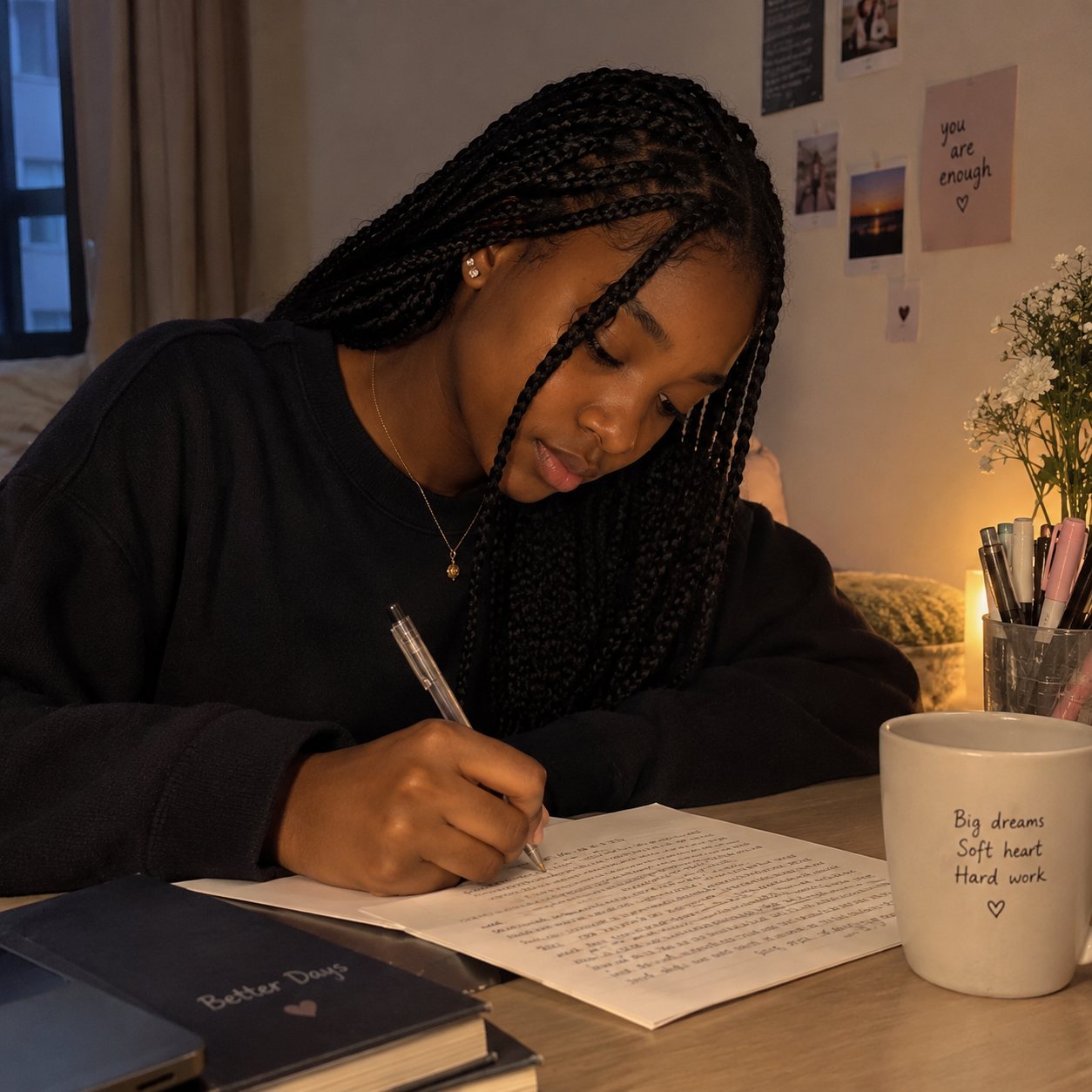
That evening, Zara returned home and opened her diary.
For years, she had written about school, friendships, disappointments, and dreams.
But never about her period.
It had always seemed too embarrassing to put into words.
This time, she picked up her pen.
Dear Womb,
I owe you an apology.
For years, I thought you were my enemy.
I blamed you for every painful morning, every stained uniform, every embarrassing moment, and every day I wished I had been born without a menstrual cycle.
I was angry because I didn’t understand you.
And the people around me taught me to remain silent whenever you tried to tell me something.
I thought being strong meant enduring pain without complaining.
I thought being mature meant hiding my sanitary pads.
I thought being a woman meant accepting every discomfort without asking questions.
But I am beginning to understand something.
You were never something to be ashamed of.
You are part of a body I am still learning to care for.
And although I may not always understand what is happening inside me, I promise to start paying attention.
I will stop treating my menstrual health like an embarrassing secret.
I will ask questions.
I will seek help when something feels wrong.
I will learn the difference between ordinary discomfort and symptoms that deserve medical attention.
Most importantly, I will never teach another girl that silence is the price she must pay for becoming a woman.
With love,
The girl who is finally listening.
When Zara finished writing, she realised something.
Her body had not suddenly become perfect.
Her cramps had not magically disappeared.
She still had medical appointments to attend and things to learn.
But something inside her had changed.
For the first time, she no longer saw menstruation as a punishment.
She saw menstrual health as a part of her wellbeing that deserved attention.
Chapter Six: The Girl in the Last Row
Months later, Zara was invited to speak at a menstrual health awareness programme in a secondary school.
She stood before a classroom filled with young girls, some curious, others shy.
On the table beside her were sanitary pads, a menstrual cycle chart, and a notebook.
She began with a question.
“How many of you have ever hidden a sanitary pad because you were afraid someone might see it?”
Almost every hand went up.
Zara smiled sadly.
She recognised herself in those raised hands.
Then she asked another question.
“How many of you know when menstrual pain might be a reason to see a healthcare professional?”
Only three hands went up.
The room became quiet.
Zara took a deep breath.
“When I was your age, I knew how to hide a pad inside my textbook. But I didn’t know how to recognise when my body needed help.”
She told them about her first period.
The stained skirt.
The laughter.
The years of silence.
The hospital visit.
And the letter she had written to her womb.
She explained that menstrual health was more than having access to sanitary pads. It also involved accurate information, hygienic practices, emotional wellbeing, access to healthcare, and the freedom to ask questions without embarrassment.
She reminded them that cycles differ from person to person and that noticing changes in their usual patterns matters.
When she finished speaking, a small hand rose from the last row.
The girl looked no older than thirteen.
“Excuse me, Aunty Zara?”
“Yes, sweetheart?”
“Is it bad if boys know we’re on our period?”
Zara looked at her for a moment.
It was the same question she had carried silently through childhood.
She walked closer.
“No, my dear. Menstruation is not something dirty or shameful. You have a right to privacy, but you should never feel that your body is something to be ashamed of.”
The girl nodded slowly.
Then she asked,
“So I don’t have to hide my pad like I stole something?”
The entire classroom burst into laughter.
Zara laughed too.
But this time, the laughter was different.
Nobody was being humiliated.
Nobody was being mocked.
A little girl was simply discovering that she had nothing to be ashamed of.
And Zara knew that something important had happened.
A cycle of silence had been interrupted.
The Final Page: A Different Kind of Inheritance
That night, Zara returned to her diary.
She opened the page containing her letter and added one final paragraph.
Dear Womb,
Today, a thirteen-year-old girl asked me a question I was too afraid to ask at her age.
And I answered her.
Perhaps I cannot erase the shame I experienced growing up. Perhaps I cannot recover every day I spent suffering in silence.
But I can make sure another girl receives the knowledge I once needed.
I used to think menstruation was a story written in blood.
Now I know it is also a story about health, dignity, education, and the right to be heard.
And this time, I refuse to let silence write the ending.
She closed her diary.
Outside, rain tapped softly against her window.
For the first time, Zara thought about the little girl she had once been, standing in a school toilet with a stained skirt and tears running down her cheeks.
If she could return to that moment, she would hold that little girl’s hands and tell her:
“You are not dirty. You are not embarrassing. You are not less deserving of dignity because your body menstruates. And when your body tells you something is wrong, you deserve to be heard.”
Because the greatest gift we can give the next generation of girls is not simply a sanitary pad wrapped discreetly in newspaper.
It is knowledge without fear.
Care without judgment.
And a world where no girl has to choose between protecting her dignity and understanding her body.
A message beyond the story
Menstrual health is not merely about the days a person bleeds. It is about physical health, emotional wellbeing, education, access to safe menstrual products, and the confidence to seek care.
A period should never become a reason for shame, and menstrual pain should never be dismissed simply because it is common.
Let us raise girls who understand their bodies, not girls who are only taught to hide them.
Because a girl who understands her body is better equipped to speak up for her health.